
How Automotive 3D Scanning Improves Vehicle Component Accuracy
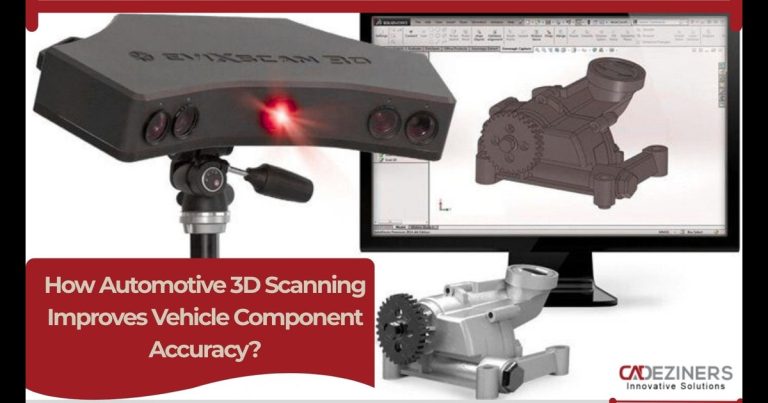
Automotive 3D scanning plays a critical role in the car industry because Accuracy is very important in the car business because even small mistakes in numbers can make a car less safe, less reliable, or less long-lasting. Engineers and constructors need increasingly powerful tools to ensure every part is perfect as cars get more complex. Because they provide perfect digital replicas of car parts, 3D scans are now essential.
By turning parts into exact 3D models, this technology helps engineers study the geometry of the real world, find mistakes, and make better products. In the car industry, Automotive 3D Scanning helps improve accuracy, cut down on mistakes, and make the whole product more reliable. From early design validation to final quality review, it applies.
What Is Automotive 3D Scanning and How Does It Work?
Lasers or structured light record millions of measurement points across an automobile part in 3D scans. With these points, a very detailed computer model of the part can be made that shows its exact shape and size.
It’s important that the measurements don’t damage the surface, that it can record high-resolution data for difficult shapes, and that it scans quickly compared to hand measuring tools.
When looking at and analysing things, this digital data with lots of information can be used as a good guide.
How Does 3D Scanning Improve Measurement Precision?
In the past, measure tools could only pick up a few points of reference, which meant that you might miss some differences. In the auto business, Automotive 3D Scanning measures the whole surface, which makes the accuracy more consistent and easy to repeat.
Some advantages of being accurate are
- Being able to find changes in sizes down to the micron level;
- Not having to rely on mistakes made by humans when measuring;
- Getting the same results from multiple checks.
This level of precision is very important for high-tolerance car parts.
How Does Automotive 3D Scanning Support Design Validation?
Design validation checks that the parts that are made match the blueprints that were used to make them. With 3D scanning, it’s easy for engineers to see how scanned parts match up with CAD models.
Here are a few important benefits:
• A picture of the differences between design and production
- Finding problems with the production process early on
- More faith before mass production
With this method, you’re less likely to have to pay a lot of money for redesigns and refunds.
How Does 3D Scanning Improve Quality Control Processes?
Quality control is better with 3D scanning for cars because it lets checks happen faster and with more information at every stage of production.
Changes to quality include
- Looking for flaws and distortions on the surface
- Making sure the assembly is correct
- Lowering the number of items that need to be thrown away or fixed.
This is why makers set high standards for their work.
How Does 3D Scanning Enhance Component Fit and Assembly?
Parts must fit right for a car to work well and make less noise. When you put parts together, 3D scanning makes sure that they line up right.
Some benefits of fitting are
- Making sure that mating surfaces are right
- Complex parts are better aligned.
- Fewer problems with placement during production
This way, it’s easier to put together and will last longer.
Conclusion
Automotive 3D Scanning is an important part of making car parts more accurate because it gives accurate full-surface measurement data. It is a useful tool in modern automobile engineering as it helps with checking the quality of designs, making production more efficient, and validating designs.
FAQs
Do 3D scans of cars only happen when they are being made?
No, it’s also used a lot in the auto business to check aftermarket parts, do reverse engineering, and make sure they work.
Are mistakes less likely to happen when 3D scans are used?
Yes, 3D scanning helps find differences early on, which cuts down on mistakes, extra work, and output delays.
Recent Posts
-
 How Australian Industries Recreate Obsolete Parts with Reverse Engineering03 Jun 2026
 -
 Reverse Engineering & 3D Printing for Automotive Aftermarket Parts29 May 2026
 -
CAD Drafting vs BIM for Construction Projects in Australia22 May 2026
-
 Top 10 Industrial Applications of 3D Printing and Their Benefits15 May 2026
 -
Minimum Wall Thickness for SLA 3D Printing: Design Guide 202608 May 2026
Categories
- Blogs
- 3D Printing Articles
- 3d Scanning Articles
- Cad Drafting Articles
- FEA Services Articles