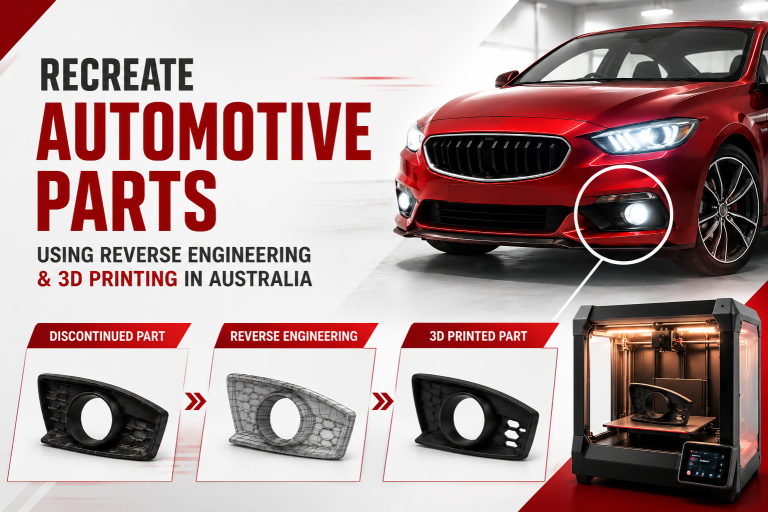
The automotive aftermarket industry in Australia is growing rapidly, and 3D Printing in Australia is helping recreate discontinued and custom automotive parts. Many car owners, restoration workshops, and performance businesses struggle to find replacement parts for older, imported, or limited-edition vehicles because OEM manufacturers often stop producing them after a few years.
Instead of searching for endless hours for unavailable OEM parts, companies can now recreate them by scanning and designing aftermarket components through modern CAD designs and additive manufacturing technologies.
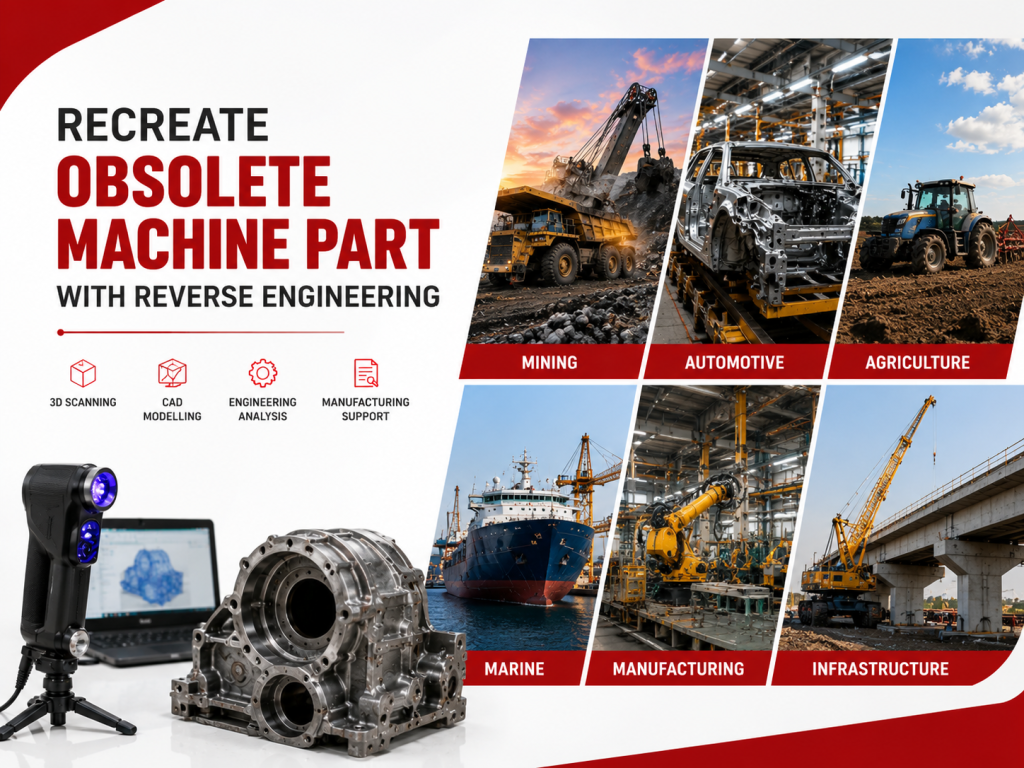
Through CADDeziners Australia, automotive reverse engineering processes assist in recreating discontinued parts, custom aftermarket designs, and vehicle restorations in Australia through advanced 3D scanning and CAD technology designs.
Why Automotive Aftermarket Parts Are Difficult to Source
Car owners believe that parts will never be unavailable. But it is not uncommon for manufacturers to stop producing the same parts when there is no more demand for the vehicle itself.
The result is a huge issue for:
- Classic car restoration
- Japanese imports
- Performance cars
- Old Holdens and Fords
- 4WD builds
- Racing projects
- Custom body kits
- Rear dashboard parts
- Interior plastics
In Australia, long waiting times and lack of availability of parts add to the difficulty.
Sometimes, just one broken dashboard clip or custom bumper bracket is enough to bring the restoration to a halt.
Real Example: Recreating a Broken Dashboard Component
One of the most popular reverse engineering projects for automobiles includes repairing broken dashboard trims and mounts.
Such repairs can include:
- Brittle plastic clips
- Cracks on vents
- Damage to center console mounts
- Broken instrument panels
Old-school production techniques would include making injection molds, which would not be cost-effective when producing a limited number of parts.
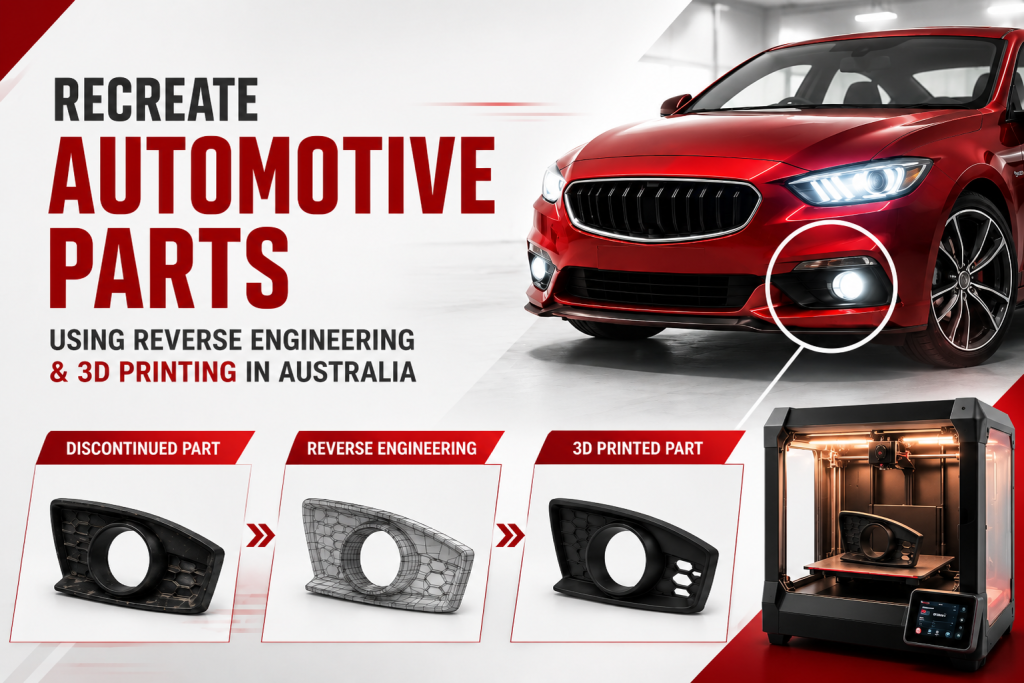
On the other hand, reverse engineering technology can assist designers by allowing them to:
- Scan a damaged part
- Reconstruct missing elements in a digital form
- Produce a precise computer model
- Optimize the weak points in the design
- Print a replacement part via industrial-grade 3D printing
As CADDeziners Automotive Services states, its reverse engineering services can be used for dashboard modification, replica manufacture, and automotive scanning for cars manufactured in Australia.
How Automotive Reverse Engineering Works
Reverse engineering is the technique of converting a physical part into its digital form.
For automotive use, the process normally requires:
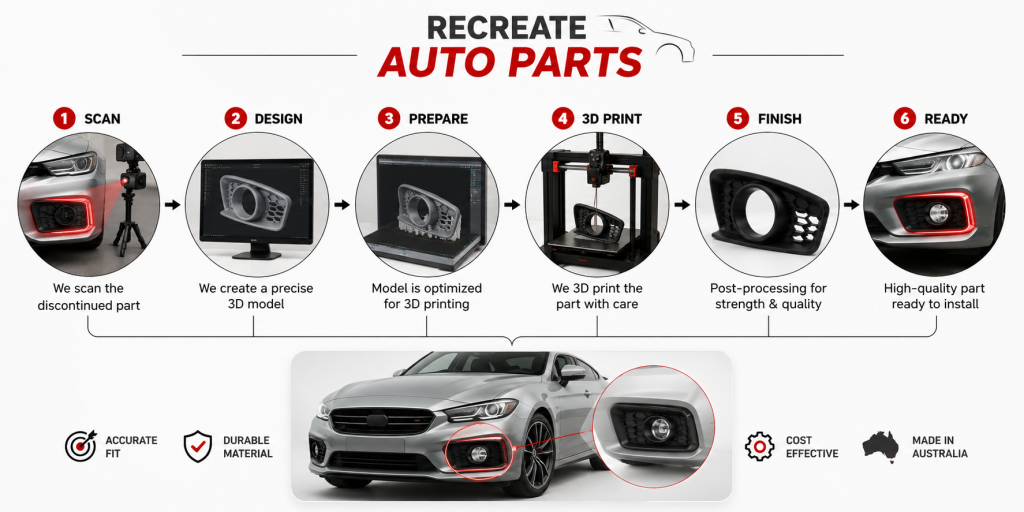
Step 1 – 3D Scanning of the Physical Part
The highly precise 3D laser scanner records the entire part’s geometry including:
- curves
- mounting points
- location of holes
- dimensions
- geometry
Current automotive 3D scanning technology is capable of recording very complex geometries much quicker than traditional techniques.
Step 2 — CAD Reconstruction
The part is then re-engineered back into a functional CAD model after scanning.
This is an essential process since the scanned mesh is generally not manufactureable.
Advantages of professional CAD engineering include:
- geometry improvement
- accuracy of dimensions
- surfaces that can be manufactured
- engineer changes
- structural optimization
CADDeziners’ reverse engineering processes center on the creation of precision CAD models.
Step 3 — Design Improvement
Another great benefit of reverse engineering is the ability to improve the original design.
Examples include:
- increased strength of plastic mounting points
- better air flow paths
- increasing the material thickness
- greater heat resistance
Such improvement is especially helpful for old cars where the original manufacturer parts frequently break down due to harsh Australian heat exposure over many years.
Step 4 — 3D Printing or Manufacturing
After the finalization of the CAD model, the part can then be made using:
- FDM printing
- SLS nylon printing
- MJF manufacturing
- CNC machining
- SLA printing
This will depend on:
- heat sensitivity
- strength
- flexibility
- aesthetics
- load
Real Automotive Applications of Reverse Engineering
Reverse Engineering Automotive Technology is not limited only to prototype designs.
Some of these uses include:
Custom Bumpers
The company CADDeziners Automotive Design Services notes that reverse engineering bumpers and re-designing processes can be done on automotive parts.
These include:
- custom body kits
- motorsports car designs
- custom 4WD designs
Replicating Aftermarket Parts
Aftermarket Replications
After a while, most aftermarket manufacturers give up production of unique parts.
Through reverse engineering, automotive workshops can duplicate:
- intake manifolds
- mounting brackets
- unique trims
- aerodynamics parts
- dash surrounds
CADDeziners especially emphasizes their ability to replicate aftermarket parts and customize car chassis.
Classic Car Restoration
Restoration work in Australia often faces difficulty in obtaining:
- Holden interiors
- rare clips
- vents
- console mounts
- switch housings
Modern scanning and additive manufacturing processes can fabricate these parts without expensive tooling charges.
Professional reverse engineering processes enable automotive parts to be digitally recreated through CAD design, 3D scanning, and additive manufacturing technology.”
Why 3D Printing in Australia Is Growing Fast
There has been an increase in demand for 3D Printing in Australia due to the following requirements by manufacturers and workshops:
- fast turnaround times
- reduced costs of tooling
- local manufacture
- rapid prototyping
- low volume manufacturing
- flexibility in custom engineering
Conventional injection molding requires thousands of dollars prior to producing a single piece.
3D printing eliminates all these tooling constraints altogether.
Hence, additive manufacturing is perfect for:
- discontinued parts
- single prototype runs
- aftermarket customization
- restoration work
Materials Used in Automotive 3D Printing
The automotive industries utilize various engineering materials due to varying requirements.
Common Automotive Materials
Material | Best Use |
ABS | Interior trims |
ASA | UV-resistant exterior parts |
Nylon PA12 | Functional brackets |
Carbon Fibre Nylon | High-strength components |
TPU | Flexible parts and seals |
SLA Resin | Cosmetic prototypes |
Selection of professional material is necessary owing to Australia’s extreme weather conditions.
Why CAD Accuracy Matters in Automotive Projects
CAD reconstruction flaws may cause:
- improper fitment
- misalignment
- installation issues
- vibration problems
Professional reverse engineering service providers pay great attention to dimensional and function testing before production starts.
This is the reason why competent CAD engineering solutions are very important for the automotive aftermarket industry.
The Future of Automotive Reverse Engineering
There is ongoing development in automotive reverse engineering because of:
- CAD design with help of AI technologies
- fast laser scanning
- industrial 3D printing technologies
- digital twin technologies
- mesh generation with high accuracy
The research on reverse engineering software for CAD systems contributes to the automated recreation of mechanical components.
Since vehicle platforms become outdated, reverse engineering will become one of the major approaches to supporting automotive systems.
Why CADDeziners Are Different
The main characteristics of CADDeziners include:
- automotive 3D scanning
- reverse engineering
- CAD drafting
- additive manufacturing
- automotive aftermarket parts redesigning
- automotive 3D printing
Contrary to general printing firms, the emphasis here is put on the engineering-oriented approach to automotive projects.
Conclusion
Australian automotive reverse engineering is evolving in relation to discontinued and customized car part issues.
The need to seek out hard-to-find stock from OEMs or costly foreign manufacturers is being replaced with the use of digital technologies including:
- 3D scanning
- CAD design
- 3D printing
In addition to the restoration and customization of auto parts, reverse engineering allows for faster production and modification of existing parts.
Are you seeking a professional Australian automotive scanning, reverse engineering, or 3D printing in Australia?
Then, discover advanced aftermarket products with CADDeziners Australia.