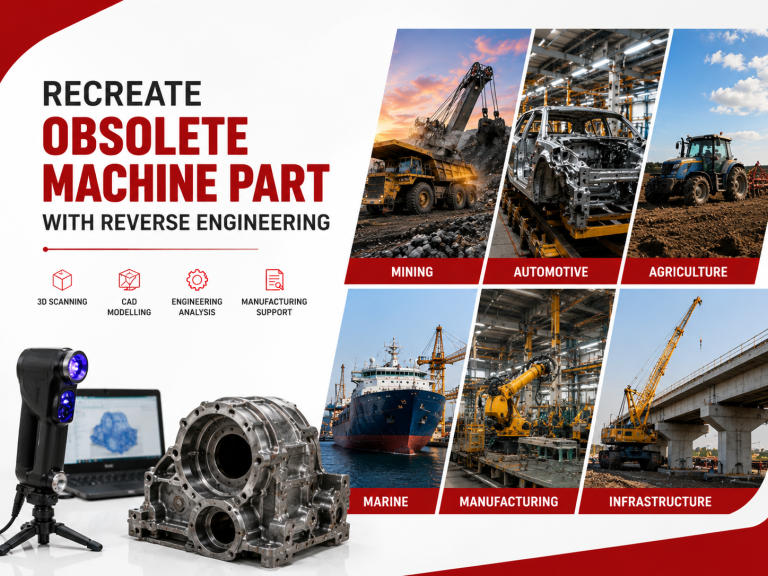
Many Australian businesses rely on equipment that has been running successfully for years. However, when a critical component is out of stock, swapping out the whole machine is expensive and simply unnecessary.
As obsolete machine parts in Australia become hard to find in Australia, industries are resorting to reverse engineering, 3D scanning, and CAD modelling to recreate discontinued parts and continue operation.
The Growing Challenge of Obsolete Machine Parts in Australia
Some of the oldest machines in the world are used in Australian industry. Mining, manufacturing, agriculture, maritime industry, and infrastructure all have equipment that has been in use for decades.
The issue does not lie with the equipment itself.
It lies in the fact that manufacturers at one point or another will stop manufacturing replacement parts altogether or simply discontinue their services in terms of providing maintenance for said equipment.
Problems include:
- Discontinuation of OEM support
- Absence of technical documentation
- Obsolete CAD documentation
- Increased international shipping time
- Global logistics problems
- High prices for replacement equipment
The value of a piece of equipment worth hundreds of thousands of dollars can be reduced to zero by the lack of availability of one particular part.
Reverse engineering provides a viable option for businesses looking for a more economical approach.
Why Replacing the Entire Machine Is Often the Wrong Decision
Once a vital piece is worn out, most companies see purchasing a new piece of machinery as the only solution.
But take the following example.
A manufacturing company uses a unique piece of machinery worth over $250,000. After 18 years of operation, a custom gearbox housing breaks due to a crack. The company stopped making this particular machine platform several years ago and does not offer any replacement housing pieces.
The replacement of such machinery would entail:
- Expensive expenses
- Disruption of work
- Training employees
- Installations
- Downtime
Reverse engineering, on the other hand, will enable the company to repair the component without scrapping an otherwise perfectly good piece of machinery.
This is much more profitable for many businesses in Australia.
What Is Reverse Engineering?
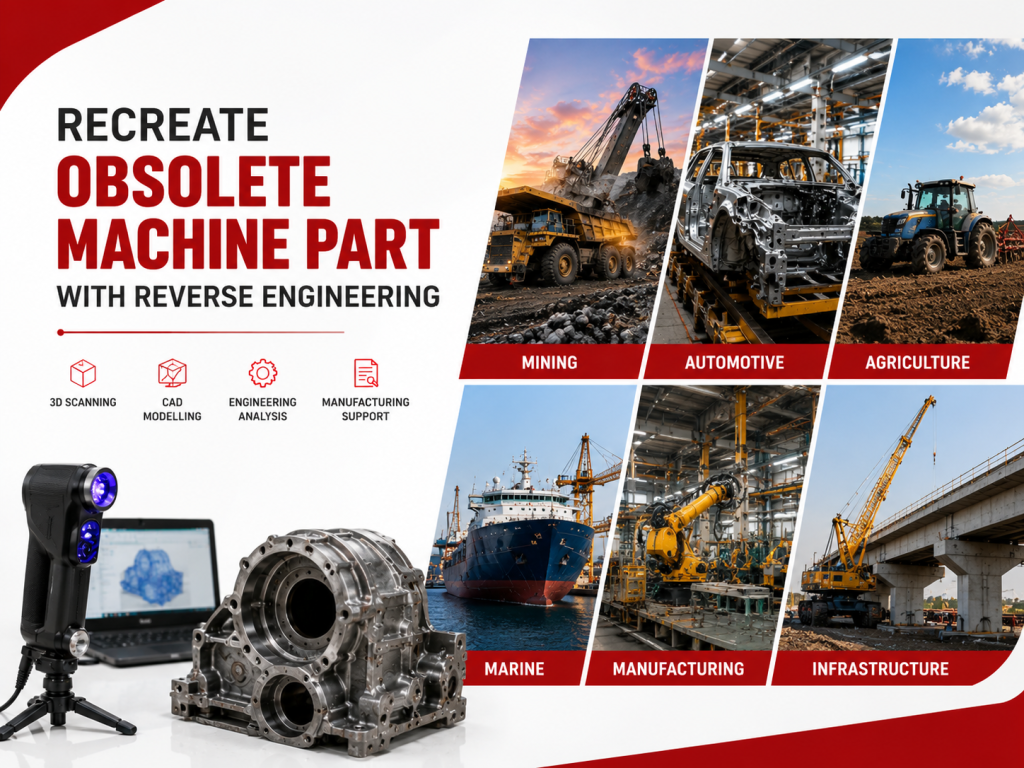
Reverse Engineering refers to the recreation of a component in situations where there are no available documents, designs, or engineering data of the original part.
With the use of advanced engineering technology, the existing part will be evaluated and converted into a digitally engineered part ready for manufacture.
At CADDeziners, the typical steps involved include:
- 3D Scanning
- Conversion of Scan to CAD
- Mechanical Drafting
- CAD Modelling
- Product Development
- FEA Analysis
- Manufacturing Documentation
This provides for the creation of a digital design of the part for repetitive manufacturing requirements.
How CADDeziners Recreates Obsolete Components
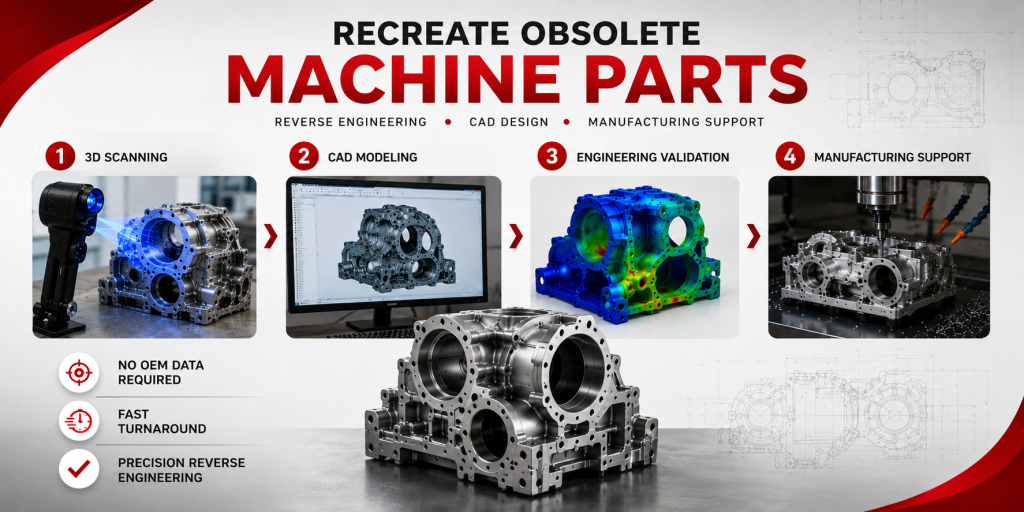
Step 1: Industrial 3D Scanning
The process starts with the acquisition of the existing part through state-of-the-art 3D scanning.
While conventional measuring methods are unable to do so, 3D scanning technology can precisely measure:
- Sophisticated geometry
- Curved surfaces
- Inner structures
- Unique forms
- Mounting points
Millions of data points are acquired to make a very precise digital model.
Step 2: Scan-to-CAD Modelling
The scanned data is transformed into a fully editable CAD file.
This step involves transforming the scan data into engineering data, which is ready to be manufactured and analyzed.
The CAD file serves as a permanent digital archive that can be utilized whenever a replacement part is needed.
Step 3: Engineering Validation and FEA
However, not all of the old parts need to be replicated as they were.
In many cases, there were problems with the designs themselves, or the materials used, or how they wore.
Using finite element analysis, FEA, designers can examine:
- Concentrations of stress
- Structural properties
- Load transfer
- Failure points
Then improvements can be made before production.
Step 4: Manufacturing Support
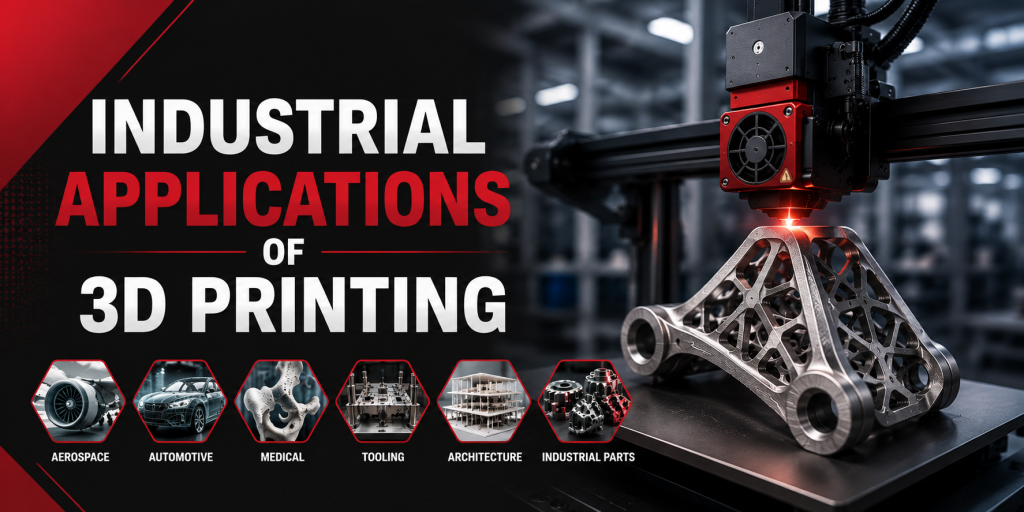
When the design is approved, it can be produced via:
- CNC milling
- Sheet metal forming
- Metalworking
- 3D printing
- Low volume manufacturing
In this way, companies can obtain parts that suit their needs without being overly dependent on foreign companies.
Mining Industry: Keeping Critical Equipment Operational
Mining is one of the most significant industries in Australia, and most of its mining companies depend on equipment that can serve them for decades.
Imagine having a conveyor system running in an isolated area within Western Australia.
Cracks begin to form on a bracket that supports one of the parts after years of use. The original manufacturer is now out of business, and importing a new bracket would take some time.
With reverse engineering, the cracked bracket would be scanned, analyzed, modeled, and reproduced locally.
Results:
- Less downtime
- More savings on replacement
- Greater equipment reliability
- Creation of a digital asset for future use
For mining organizations, this strategy can greatly mitigate their risks.
Manufacturing Industry: Avoiding Production Downtime
Factories rely on efficient machines to fulfill production targets.
Failure of obsolete machine parts can result in production delays and high costs.
The following are some common parts reproduced using reverse engineering:
- Gear housing
- Conveyor belt assembly
- Machine guard
- Roller
- Mounting bracket
- Tool fixture
The lifespan of the equipment is therefore extended without having to replace the whole manufacturing line.
Automotive Industry: Recreating Parts No Longer Available
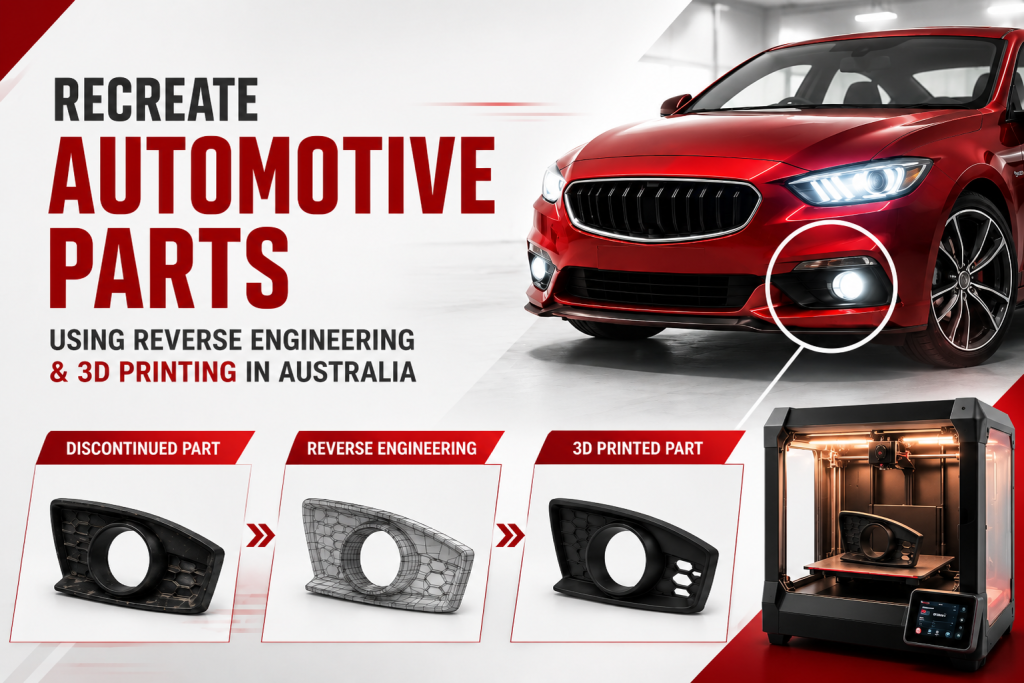
Discontinued automotive parts are common occurrences, especially for vintage cars, industrial machines, truck fleets, and restoration projects.
With reverse engineering, the following can be created:
- Engine mounts
- Interior parts
- Fastening systems
- Specialized housings
- Outdated vehicle parts
This process ensures that useful vehicles and machinery continue functioning properly and remain intact.
Marine Industry: Solving Legacy Equipment Challenges
Challenges may arise in the procurement of componentry used on older ships or specialized machinery.
Applications include:
- Pump casings
- Engines
- Housings
- Props and propulsion
- Structural fittings
Recreating lost parts allows marine organizations to sustain performance without the need for total system replacement.
Architecture and Signage Industries: Supporting Custom Projects
Architecture and sign projects often have unique parts built for them, which are no longer commercially available years down the road.
Reverse engineering assists with:
- Heritage conservation projects
- Specialized structural brackets
- Architecture fixings
- Signage production machinery
- Decorations
This helps companies keep the same design intact while fulfilling engineering needs.
The Competitive Advantage of Digital Part Libraries
The future-oriented companies are not waiting until the equipment breaks down.
Rather, they create a virtual library of essential parts before the breakdowns happen.
Advantages include:
- Time saved on future replacements
- Lower downtime periods
- Better planning for maintenance needs
- Increased reliability of the supply chain
- Money saved in the long run
After modeling the part using reverse engineering once, it is ready to be replicated.
Conclusion
It is now common for outdated machine components in Australia to become an issue within multiple industries. From mining, manufacturing, automotive, marine, architecture, and signs, businesses are under threat because of discontinued parts and equipment.
However, the process of reverse engineering offers a viable option. Using high-tech solutions such as 3D scanning, CAD modeling, engineering analysis, and fabrication, Australian companies can effectively replace the necessary component without incurring the cost of machine replacement.
Need to Recreate an Obsolete Machine Part?
When it comes to sourcing unavailable components, our company will assist you. By applying reverse engineering, industrial 3D scanning, CAD modeling, FEA analysis, and product development, CADDeziners allows businesses across Australia to recreate outdated machine parts.
Contact CADDeziners today to discuss your project and discover how reverse engineering can keep your equipment operating for years to come