
Get 3D Printed Custom Medals in Australia
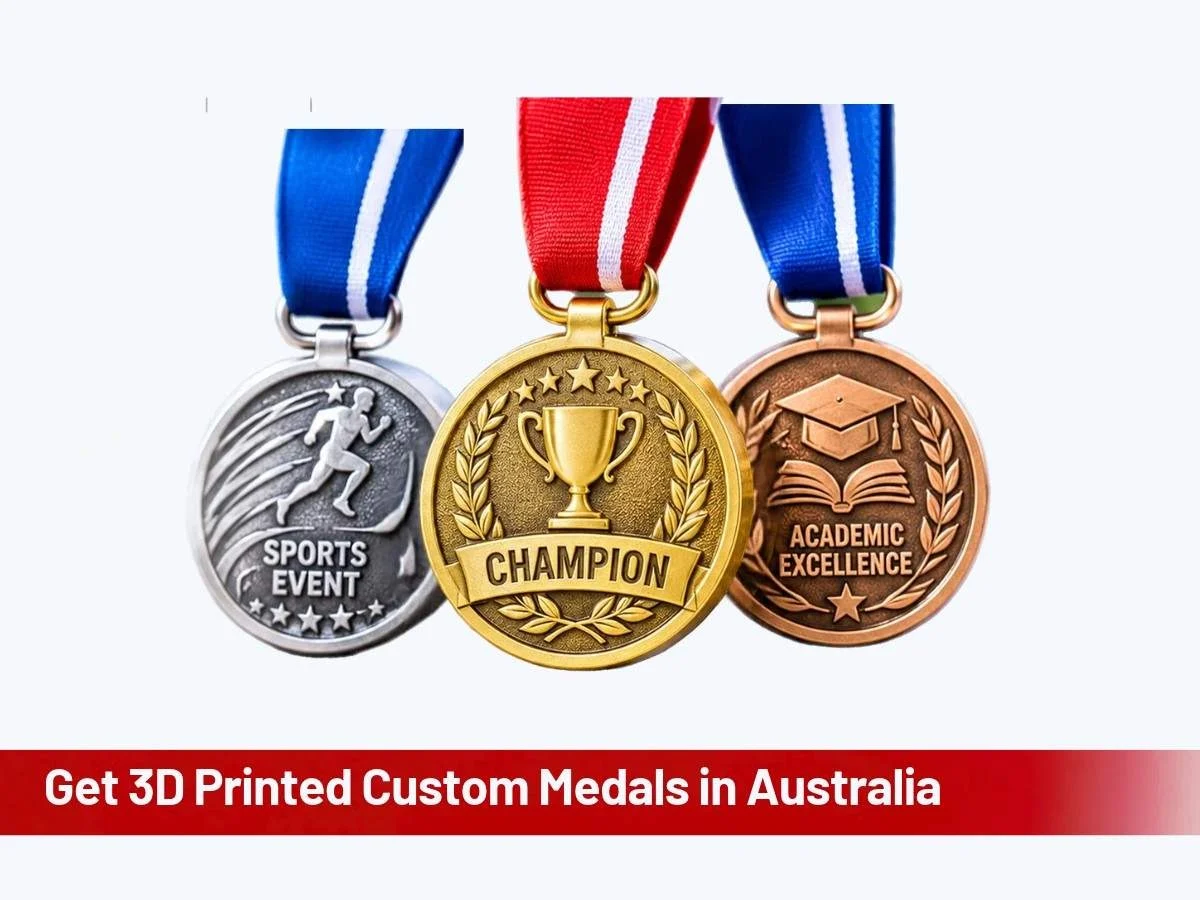
Sporting clubs, schools, universities and corporate teams across Australia are rethinking how they make recognition awards. Die-struck and cast medals are still used but steel dies or moulds are required (long lead times), large minimum runs are needed and 3D printing eliminates most of these constraints. More organisations now turn to additive manufacturing when they need custom medals Australia wide whether that’s a prototype, short event run or fully sculpted award.
This guide covers the technical points that make a printed medal look premium or amateur: process selection, CAD design rules, finishing and durability.
Why 3D Printing Suits Custom Medals in Australia
With traditional medal production tooling is needed before a single piece is made so the cost is spread over the run (small orders are expensive, design changes require new tooling). Additive manufacturing works from a digital file directly. A revised logo, different diameter or new event year just edits the CAD model not cut a new die.
For Australian event organisers this has three practical benefits:
- Low volume viability: 10, 25 or 80 medals run without tooling costs.
- Geometric freedom: Sculpted relief, undercuts, open-work lettering, portrait features and non-circular outlines are all possible.
- Fast iteration: design proofs can be printed and physically checked before the final batch.
Choosing the Right 3D Printing Technology
The print process determines surface quality, strength and finishing potential.
- SLA/DLP resin printing is the usual choice for detailed medals. Layer heights of 25 to 50 microns reproduce fine text, crests and textured backgrounds with a smooth surface that takes paint and plating well. Standard resins are brittle so tougher engineering resins work better for medals that will be handled often.
- Nylon printed SLS and MJF are tough but flexible (no support marks), grainy surface (matte or antique style finish) so good for those finishes, drops don’t wear it well.
- FDM printing is cheapest but has visible layer lines and poor fine detail capability. It’s good for large simple profile medals or prototypes rather than premium presentation pieces.
- Metal printing (DMLS or binder jet) gives true metal medals but the cost goes up steeply. It is used mainly for high value commemorative pieces.
For most organisations ordering custom medals Australia wide resin or nylon printing with professional metallic finishing gives the best balance of detail, weight and cost.
Design Rules for Printable Medals
A model that looks good on screen will not work in print. These CAD guidelines apply to most processes:
- Overall thickness: 3 to 5 mm gives a solid feel and prevents warping. Thin medals feel flimsy in the hand.
- Relief height: Raise elements 0.6 to 1.2 mm high so that they are cleanly defined without too much overhang.
- Minimum text size: Stroke width of at least 0.5 mm and character height of 2 mm or more (sans-serif or slab-serif fonts hold up better than thin script fonts).
- Ribbon bail or hole: 2.5 mm of material around a 4 to 5 mm hole. Reinforce the loop area since it carries the weight of the medal.
- Edge treatment: A small chamfer or fillet on the rim gives comfort and finishing coats better adhesion.
Files should be supplied or exported as STL, 3MF or STEP. Logos work best as vector art (SVG, AI or PDF) so they can be extruded cleanly instead of traced from a low resolution image. If a medal needs likeness or custom sculpt it can be built from reference photos or 3D scan.
Finishing: Where Quality Is Won
Raw prints don’t look like medals. Professional finishing makes them awards:
- Surface preparation: Support removal, wet sanding and filler primer remove layer lines.
- Metallic coating: Gold, silver and bronze finishes are obtained from metallic paints (metallic powders in clear binder), or electroplating over a conductive layer.
- Antiquing: Selective washes darken recesses and raise raised detail so the classic antique gold, silver and bronze look is achieved.
- Colour fill: Enamel-style colour can be hand applied into recessed areas (club colours).
- Protective clear coat: A UV-stable lacquer prevents tarnishing and handling wear (which is important for medals worn outdoors at events).
Durability and Practical Considerations
Medals are worn, dropped and stored for decades so material choice should reflect that use — nylon prints take the most impact; resin prints should be UV-cured fully and sealed to prevent yellowing and brittleness. Ribbon attachment points need extra care: a printed loop can be reinforced with a metal jump ring or heavier bail design.
Weight also influences perceived value. Printed medals are lighter than solid zinc alloy but finishing, thickness and presentation packaging (velvet pouches, boxes, cases) can close that gap noticeably.
Where 3D Printed Medals Work Best
Printed medals work well for:
- Tournaments with changing yearly designs;
- School award programs that run in small quantities;
- Corporate milestones recognition;
- Individually numbered or personalized awards;
- One-off sculpted pieces.
Very large runs of identical medals may still be cheaper to cast traditionally (and a good supplier will tell you so).
Order Your 3D Printed Custom Medals in Australia
Whether you are having an event, school program or corporate recognition scheme CAD Deziners can design and produce 3D printed custom medals for you. Logo extrusion, sculpted artwork, finishing and ribbon options; we do the technical work so your awards look as good as the achievement they represent.
Contact CAD Deziners today to discuss your design, quantity and timeline and get a quote for your custom medals Australia project.
Recent Posts
-
 How Australian Industries Recreate Obsolete Parts with Reverse Engineering03 Jun 2026
-
 Reverse Engineering & 3D Printing for Automotive Aftermarket Parts29 May 2026
-
CAD Drafting vs BIM for Construction Projects in Australia22 May 2026
-
 Top 10 Industrial Applications of 3D Printing and Their Benefits15 May 2026
-
Minimum Wall Thickness for SLA 3D Printing: Design Guide 202608 May 2026
Categories
- Blogs
- 3D Printing Articles
- 3d Scanning Articles
- Cad Drafting Articles
- FEA Services Articles