
Reverse Engineering vs Buying New Equipment: Which Delivers Better ROI
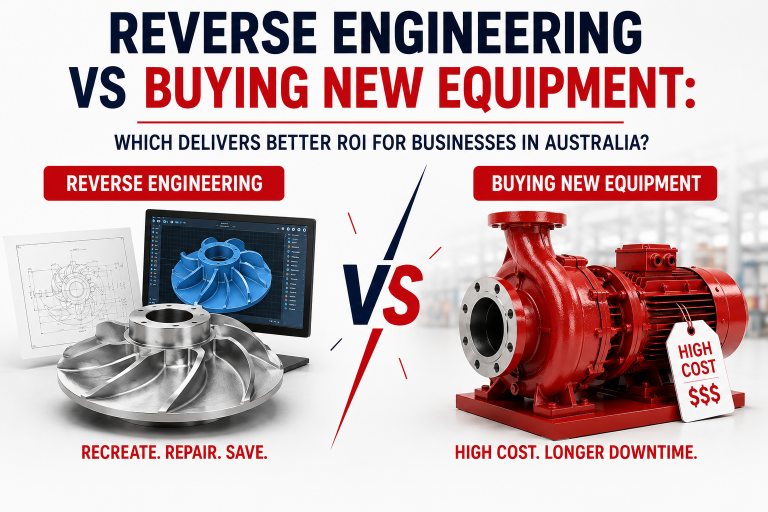
The role of reverse engineering in Australia is enabling companies to avoid unnecessary machine replacements and save on expensive downtime by reproducing the failed component instead of replacing the entire machine.
In most cases, failure occurs due to one worn-out, faulty, or obsolete component and not because the system itself has failed.
Thanks to the latest technologies in reverse engineering, including 3D scanning, CAD modeling, and local manufacturing, Australian companies have the option of cheaper and more effective solutions.
In this guide, we will discuss the cost of reverse engineering compared to replacement and help you make the engineering and economic decision.
Executive Summary
Before making any investments in replacement equipment, companies must consider:
✔ The remaining life cycle of the equipment
✔ The costs of downtime
✔ The availability of spare parts
✔ The capital investments required
✔ Potential supply chain risks
✔ Performance requirements of assets
✔ Investment return
In some cases, reverse engineering of the broken component will yield similar results but at much lesser costs.
Why Is Equipment Replacement an Automatic Choice?
Most organizations make automatic efforts to replace their equipment due to:
- The preference by OEM for selling newer equipment
- Non-availability of engineering documentation
- Lack of knowledge regarding reverse engineering in the organization
- Purchase process favoring replacements
- Managements’ assumption that replacements reduce risks.
This decision ignores the high hidden costs incurred in the process of equipment replacement.
Additional Expenses Involved When Purchasing Equipment
Most decisions about buying equipment tend to concentrate on the cost of acquiring the equipment.
There are many costs involved in replacing your equipment.
Capital Expense (CAPEX)
Replacement of equipment in industries will require a lot of expenses.
Type of Equipment | Amount of Investment Involved |
Industrial Pumps | $20,000 – $250,000+ |
Marine Equipment | $50,000 – $500,000+ |
Manufacturing Equipment | $50,000 – $1 Million+ |
Mining Equipment | $100,000 – Many Million Dollars |
The cost of acquisition is not all you have to pay.
Cost of Downtime
Sometimes the cost of downtime is the greatest cost involved.
The costs include:
- Delivery from vendors
- Shipping time
- Scheduling installation
- Testing and commissioning
- Training of the operator
For manufacturing plants, mining operations, and marine vessels, downtime might easily exceed the cost of the replacement component.
Case Example
A production facility that generates income at $15,000 per day that stays down for twenty days can lead to:
$300,000 lost production opportunity
without accounting for the cost of the replacement.
Engineering & Integration Fees
Typically for new systems there will be the need for:
- Foundational change
- Mechanical engineering adjustments
- Electrical alterations
- Software integration
- Commissioning assistance
This is almost never included in early procurement discussions.
Spares & Maintenance Differences
A replacement system could require:
- New maintenance process
- Holding of new spares
- Training of staff
- New service agreements
The recurring nature of these fees adds to the cost of ownership.
Downtime: The Hidden Cost of Equipment Failure
Too many companies overlook the cost of equipment downtime because they only look at immediate repair costs.
Hidden costs might include:
Direct Costs
- Reduced production
- Unproductive labor costs
- Costs incurred through contractors
- Equipment leasing
Indirect Costs
- Customer non-delivery
- Production scheduling
- Overtime charges
- Logistical difficulties
- Reputational harm
In terms of mining, shipping, and manufacturing, downtime is likely the biggest risk faced with equipment failure.
The Case For Reverse Engineering
Reverse engineering is utilized not only to fix broken machines but also as a tool in asset lifecycle management.
In place of changing the whole machine, engineers reverse engineer the faulty part while retaining all of the value of the asset.
Reverse engineering is most suitable for use when:
- OEM cannot be reached
- The parts have gone out of production
- Available drawings have been lost
- Machine functions mechanically well
- Budget limitations prevail
- Downtime expenses are considerable
Reverse Engineering Criteria Before Equipment Replacement
Prior to deciding on replacement costs, engineering must evaluate:
Asset Remaining Life
Replacing the failed component in a machine with an additional 5-15 years of useful life could result in a much higher ROI than replacing the entire machine.
Structural Soundness
Important considerations include:
- Is the structural integrity of the frame intact?
- Are all systems working properly?
- Is the machine producing efficiently?
If the answer is affirmative, then replacement is not necessary.
Failure Mode Assessment
Engineers must analyze whether:
- The failure was an isolated case?
- Is it a regularly worn-out component?
- Or does it reflect the deteriorating condition of the entire system?
Spare Parts Availability Risks
Companies must consider:
- OEM support status
- Lead time risks
- Long-term availability of spare parts
- Reliability of the supply chain
Reverse engineering mitigates reliance on suppliers.
Reverse Engineering VS. Equipment Replacement: Cost Comparison
Case Study Example
An industrial plant suffers from malfunction of an important pump impeller.
Support from the OEM stopped several years back.
Plan A: Replace Whole Pump System
Cost Element | Estimate |
Pump System | $45,000 |
Shipping and Handling | $4,000 |
Installation Fee | $5,000 |
Testing | $2,500 |
Losses from Downtime | $30,000 |
Integration Cost | $2,000 |
Total Cost Estimate | $88,500 |
Plan B: Reverse Engineer the Impeller
Cost Element | Estimate |
Component Analysis | $500 |
3D Scanning | $1,500 |
Design Modeling | $2,000 |
Engineering Validation | $1,500 |
Manufacture of New Impeller | $5,000 |
Installation of New Impeller | $1,000 |
Total Cost Estimate | $11,500 |
Potential Saving
$77,000+
This type of cost differential explains why reverse engineering is increasingly adopted across Australian industry.
Reverse Engineering Vs Replacement – Decision Matrix
Evaluation Criteria | Reverse Engineering | New Machinery |
Machinery is Still in Working Condition | ✅ | ❌ |
OEM Parts No Longer Available | ✅ | ❌ |
High Downtime Impact | ✅ | ❌ |
Budget Restriction on Capital | ✅ | ❌ |
Need for Significant Upgrade to Technology | ❌ | ✅ |
Regulatory Compliance Changes | ❌ | ✅ |
Equipment Almost at End of Useful Life | ❌ | ✅ |
Increase in Production Capabilities Required | ❌ | ✅ |
Scenario Description – Replacement of Marine Pump Housing
Issue
A shipowner faced a breakdown of the marine pump housing when undergoing routine servicing.
The supplier/manufacturer had ceased production well beyond a decade back.
Difficulties involved were:
- Lack of drawings
- Lack of spares
- Delayed supply chain from OEM
- Possible disruption to shipping
Analysis
The rest of the pump system was working fine.
Full replacement required:
- Replacement of equipment
- Modifications to mechanical systems
- Extra costs for installation
Solution Provided
The existing part was:
- Reverse engineered
- Digitally mapped
- Modelled in CAD software
- Manufacturing ready
Result
The shipowner was able to avoid replacing the entire system.
Areas For Design Improvement
The reverse engineering process creates opportunities to enhance design.
Materials Advancements
Advanced materials can provide:
- Enhanced wear resistance
- Enhanced corrosion resistance
- Extended part lifetime
Shape Optimization
Advanced engineering may uncover:
- Areas of stress concentration
- Areas susceptible to fatigue failure
- Unnecessary material use
Better designs will ensure higher reliability.
Process Enhancements
Advances in manufacturing technology may result in:
- Lower cost
- Shorter lead time
- Less variation
And thus better performing parts.
Why Australian Businesses Are Selecting Reverse Engineering Solutions
A number of market drivers explain the increased interest.
Lifetime Extension
Many pieces of equipment last decades.
Challenging Supply Chains
Imports are associated with:
- Longer lead times
- Delivery uncertainties
- Higher costs
Increasing Capital Costs
Replacing older equipment becomes more expensive each year.
Local Production Capability
The capability of the local Australian engineering industry to produce high-quality replacement parts increases each year.
Industrial Sectors Utilizing Reverse Engineering
Manufacturing
- Component machinery
- Tooling systems
- Production machinery
Mining
- Wear resistant components
- Crusher assemblies
- Pump systems
- Conveyor components
Marine
- Propellers
- Impellers
- Pump housings
- Assemblies
Food Processing
- Conveyor systems
- Machinery
- Processing systems
Infrastructure and Utilities
- Old mechanical components
- Custom assemblies
- Maintenance components
Why Choose CAD Deziners?
CAD Deziners offers complete engineering services for Australia-based industries.
Capabilities:
Reverse Engineering
Design of obsolete, damaged, and unsupported parts.
3D Laser Scanning
Creation of highly accurate 3D models of existing parts.
CAD Modelling
Development of manufacturing models.
Product Design and Development
Conversion of design ideas into real products.
Mechanical Drafting
Engineering drawing services for manufacturing.
Manufacturing Services
Support of prototype and production manufacturing processes.
Our staff collaborates with clients from manufacturing, mining, marine, industrial, and infrastructure industries to minimise downtime and optimise the use of assets.
Conclusion
When making the choice between reverse engineering and purchasing new equipment, you should consider the overall cost of operation throughout the entire lifespan of the equipment.
By opting for reverse engineering services, Australian companies will get the following benefits:
✔ Reduction of capital costs
✔ Minimisation of downtime
✔ Decrease in project turnaround
✔ Increase in longevity of equipment
✔ Enhancement of asset performance
Before spending on costly new equipment, companies should determine whether reverse engineering would provide a similar result at a significantly reduced price.
Recent Posts
-
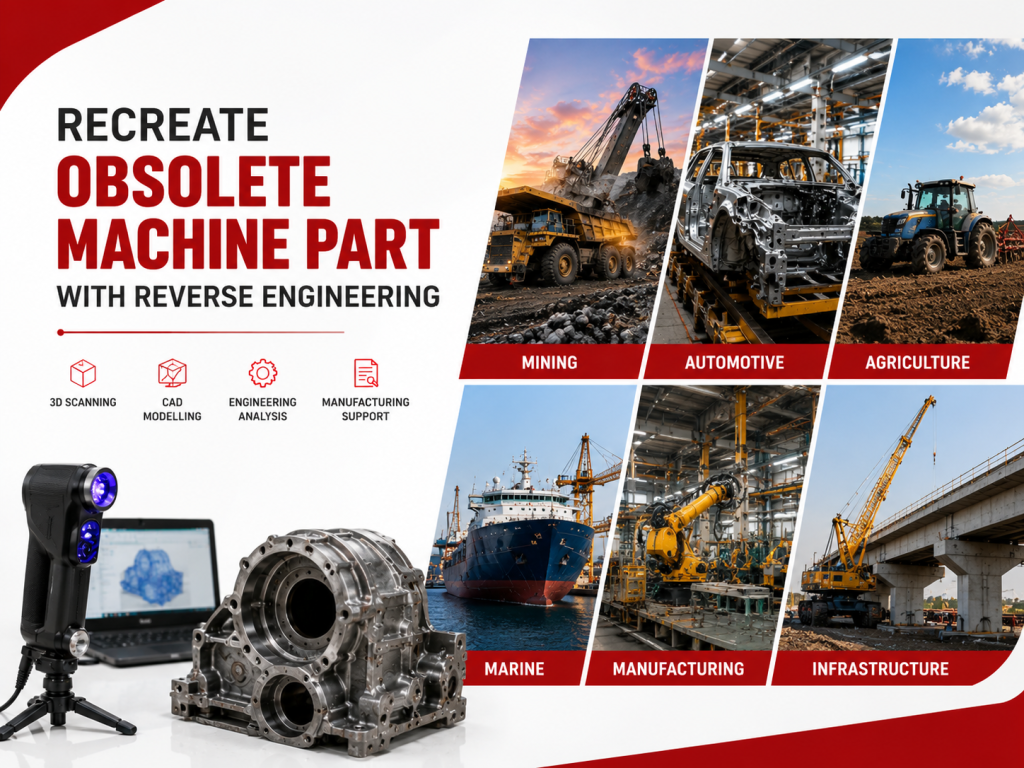
 How Australian Industries Recreate Obsolete Parts with Reverse Engineering03 Jun 2026
 -
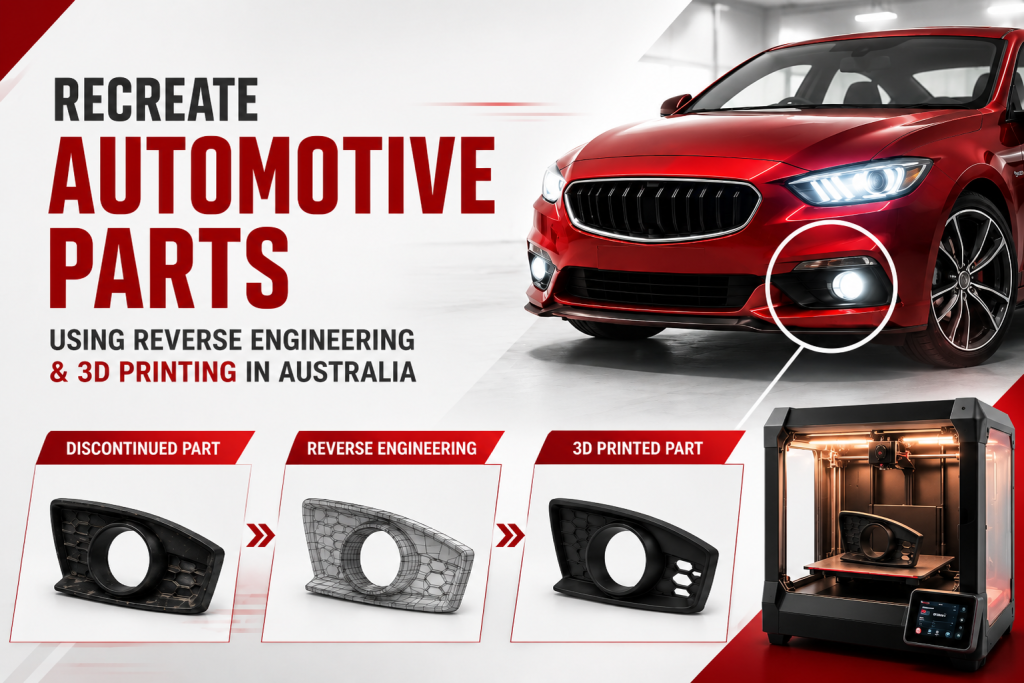
 Reverse Engineering & 3D Printing for Automotive Aftermarket Parts29 May 2026
 -
CAD Drafting vs BIM for Construction Projects in Australia22 May 2026
-
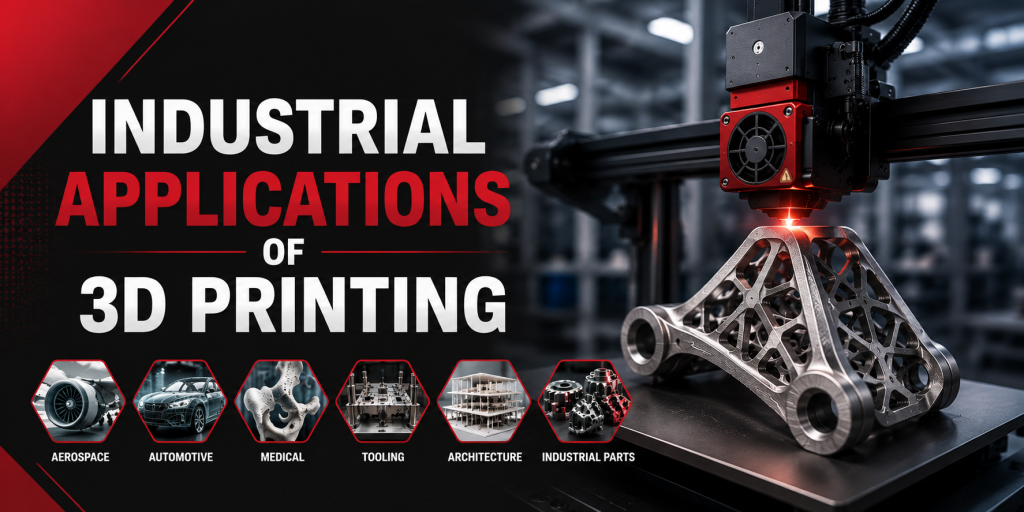
 Top 10 Industrial Applications of 3D Printing and Their Benefits15 May 2026
 -
Minimum Wall Thickness for SLA 3D Printing: Design Guide 202608 May 2026

Categories
- Blogs
- 3D Printing Articles
- 3d Scanning Articles
- Cad Drafting Articles
- FEA Services Articles
Frequently Asked Questions
Find answers to common questions
Yes, reverse engineering aims to replace only the defective part.
Yes, with the help of advanced 3D scanning and CAD modelling.
Yes, engineers can enhance material choice, shape, and manufacturing process.
Yes, because part reconstruction can allow organisations to get back to work faster than acquiring new equipment.
Yes, provided that the process is done legally and according to all relevant IP rights and contracts.