
3D Printing Service Canberra for Prototypes, Parts & Models
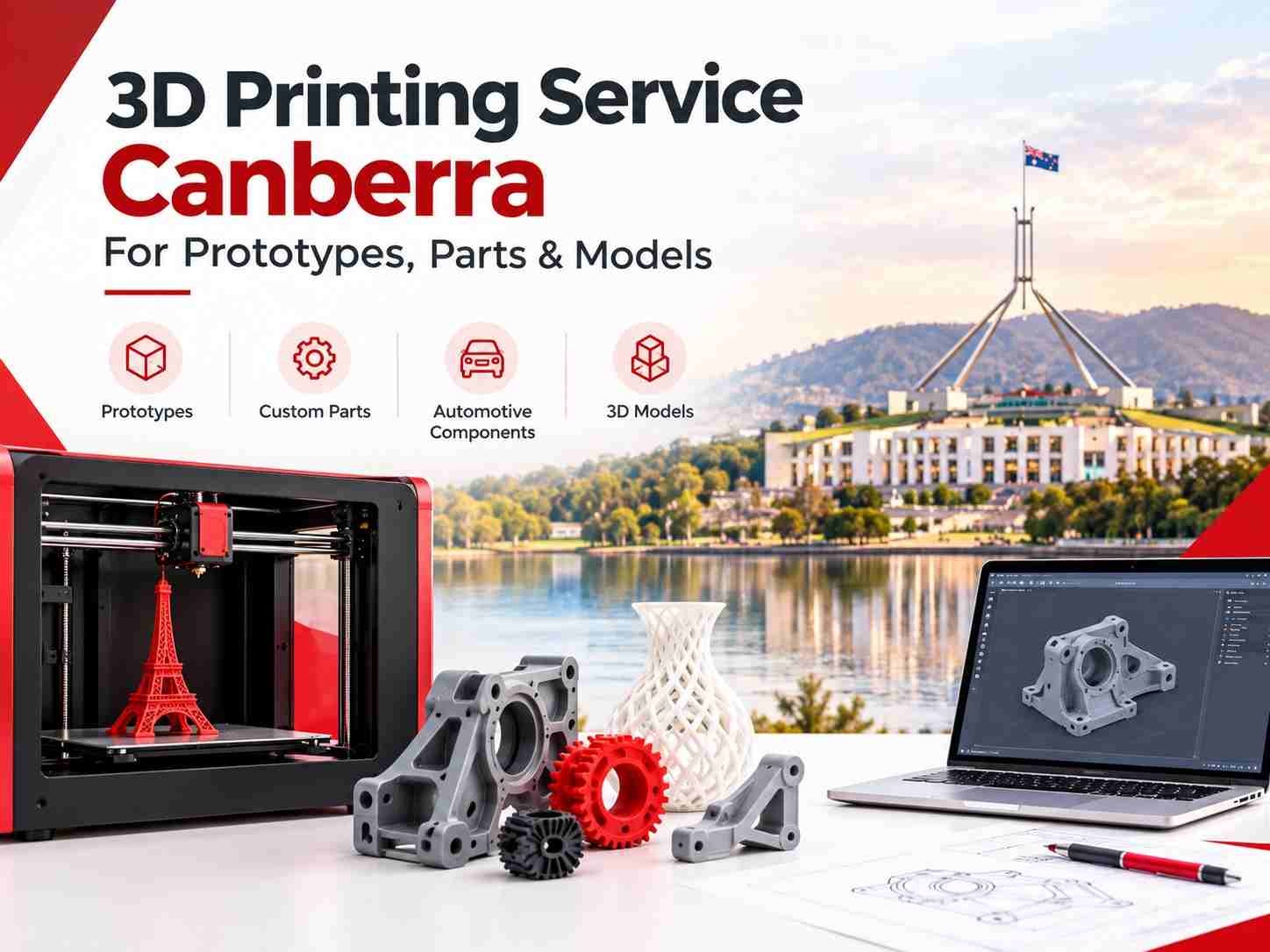
From engineering prototypes and automotive components to custom models and replacement parts 3D printing has become a practical manufacturing solution for businesses that need speed, flexibility and design freedom.
When companies are looking for a 3D printing service Canberra the real question isn’t where to print a part but rather who can do it right — someone who knows what the application is, the material, design requirements and intended use of the finished component.
Whether you are creating a new product, testing an engineering concept, recreating an obsolete part or producing a custom model, professional 3D printing can take an idea from CAD file to physical object without the tooling requirements of many traditional manufacturing methods.
CAD Deziners provides 3D printing services across Australia for applications in engineering, manufacturing, automotive, medical and design. Technologies available include FDM, SLA SLS MJF PolyJet metal 3D printing.
Why Businesses in Canberra Use 3D Printing?
Traditional manufacturing can involve moulds, tooling, machining and multiple stages of production. Those processes are still necessary for many applications but they may not be practical when you only need one prototype, a custom component or a short run.
3D printing can be very useful when a business needs to:
- Make prototypes quickly.
- Test a new product design.
- Make custom parts.
- Manufacture low-volume parts
- Check physical dimensions before production
- Make presentation or demo models
- Replace hard to source components
- Produce complex geometries
- Make design revisions without expensive tooling
An engineering team can shorten the distance between CAD design and physical testing with this capability.
Instead of waiting until the last stage of manufacturing to find a design problem, a physical prototype can give you an opportunity to inspect the part, fit it and change it earlier.
3D Printing for Engineering Prototypes
Prototyping is one of the most valuable applications of additive manufacturing.
A CAD model may look correct on a computer screen but a physical prototype will show issues that aren’t immediately obvious digitally.
For example, you may discover:
- A component is hard to assemble.
- Two parts are touching each other.
- A handle is uncomfortable to use.
- A bracket needs more support.
- A mounting hole needs adjusting.
- The overall size isn’t right.
- A component needs reinforcement.
Making these changes at the prototype stage is much easier than changing tooling or committing to production volume.
CAD Deziners specifically positions its 3D printing capabilities for prototypes, product development and production support.
From CAD File to Physical Part
Professional 3D printing starts with digital information.
Depending on the project you may already have a 3D CAD model in one of these formats:
If so, great! You’re ready to go. If not, read on.
- STL.
- STEP.
- IGES.
- OBJ.
- 3MF
CAD Deziners’ quotation system currently supports many common CAD and 3D printing file formats (e.g. 3MF, IGES, OBJ, STEP, STL and WRL).
If you already have a production-ready CAD file it can be fairly straight forward.
If your design still needs work then CAD drafting, product development, reverse engineering or 3D scanning may be required before the part is ready for printing.
This is where working with an engineering-oriented 3D printing provider can be helpful.
Choosing the Right 3D Printing Technology
There isn’t one 3D printing technology that works for every project.
The right process depends on the required strength, accuracy, surface finish, geometry, material, quantity and application.
Fused Deposition Modelling (FDM) builds parts by depositing thermoplastic material layer-by-layer.
It can be suitable for:
- Functional prototypes.
- Engineering parts.
- Jigs and fixtures.
- Concept models.
- Low volume parts.
FDM can offer a practical balance between cost, strength and material choices.
Stereolithography (SLA) uses UV-curable resin to create highly detailed components.
It may be used when appearance, fine detail and surface quality are important.
Potential applications include:
- Detailed prototypes.
- Medical models
- Product presentation models
- Complex components
- Design verification
CAD Deziners says SLA is used for applications where fine detail, precision and smoother surface quality are required.
Selective Laser Sintering (SLS) fuses powdered material with a laser to make a solid component.
It can be used for functional prototypes and short-run manufacturing where strength and complex geometries are needed.
HP Multi Jet Fusion (MJF) is used to produce consistent detailed functional parts and can be useful when businesses need multiple components with repeatable results.
For some engineering applications metal additive manufacturing can produce components from stainless steel, aluminium and titanium.
The right technology should be selected based on the engineering requirements, not just choosing the newest or most advanced process.
3D Printing for Custom Parts & Replacement Components
One of the most practical uses of 3D printing is producing a part that does not exist anymore (e.g., a component not manufactured in the original design).
An older machine, vehicle or piece of equipment may have a plastic bracket, cover, housing, mounting component or other custom part that is hard to find.
If the original component is available then it can be measured or scanned and made into a digital CAD model.
The workflow can look like:
Existing component → 3D scanning/measurement → CAD model → design correction → 3D printing → physical inspection
For businesses that have obsolete equipment, this can be an alternative to endlessly searching for an original replacement.
CAD Deziners also offers 3D scanning, reverse engineering and CAD related services so if you have a physical component that needs to be recreated digitally then CAD Deziners can help.
Creating Models for presentations and demonstrations
3D printing is not just functional engineering parts.
Businesses can also use printed models for:
- Product demonstrations.
- Architectural concepts.
- Industrial models.
- Educational models.
- Trade shows.
- Design presentations.
- Client approvals.
- Visual prototypes.
A physical model can make it much easier for a client, investor, engineer or stakeholder to understand the size, shape and appearance of a proposed product.
This is particularly true when the final product is too large, expensive or complex to manufacture at an early stage in design.
3D Printing for Automotive Applications
Automotive companies are using additive manufacturing for design, prototyping and custom parts development.
Applications can include:
- Interior components.
- Brackets.
- Housings.
- Dashboard components.
- Custom fixtures.
- Concept parts.
- Replacement parts.
- Prototypes for aftermarket products.
CAD Deziners shows automotive applications (models, dashboards, lightweight brackets and other components) that can be produced to design and engineering development.
For automotive projects material selection becomes crucial because a visual prototype and functional prototype might have very different requirements.
What Should You Ask a 3D Printing Service Before Ordering?
If you are comparing providers for a 3D printing service Canberra, don’t base your decision solely on the advertised price.
Ask questions such as:
Can You Work With My CAD File?
Check if the provider supports your file format and whether design needs extra preparation.
Which Technology Is Suitable?
Ask why FDM, SLA, SLS, MJF, PolyJet or metal printing is right for your application.
Which Material Should I Use?
The right material depends on strength, flexibility, temperature resistance, appearance and intended use.
What Accuracy Can I Expect?
For engineering components dimensional accuracy may be more important than making a model that looks correct.
Can You Modify the CAD Design?
If your design needs changing then a provider who has CAD engineering capabilities may be able to help you before printing.
Can You Produce Small or Large Quantities?
Your requirements may start out with one prototype and then grow to several parts. If you know what production capabilities are available early in the project it can save time when the project evolves.
Why Choose an Engineering-Focused 3D Printing Partner?
A basic 3D printer can print an object but professional manufacturing needs more than pressing “print”. An engineering-focused provider can help you consider:
- Design: Is the model suitable for the selected process?
- Production: Are all components available to manufacture the product?
- Maintenance: Can the model be maintained easily and quickly?
- Material: Will the chosen material perform in the intended application?
- Technology: Is FDM, SLA, SLS, MJF or another process appropriate?
- Accuracy: Are the required dimensions achievable?
- Function: Does the part need to be subjected to mechanical loads or environmental conditions?
- Finishing: Does the final component need a certain surface appearance?
This approach can be particularly useful for B2B projects where the printed component needs to do more than look good.
CAD Deziners: 3D Printing Services Across Australia
CAD Deziners offer customised 3D printing solutions for businesses across Australia combining additive manufacturing with CAD and engineering skills. FDM, SLA SLS MJF PolyJet metal 3D printing options are available for different applications.
Its broader capabilities include mechanical drafting, product development, 3D scanning, reverse engineering (also known as reverse manufacturing), CNC machining and other manufacturing services.
This broader engineering capability can come in handy when the project starts with something more complicated than a ready-to-print CAD file.
For example, you may have an existing component that needs to be scanned, redesigned and then manufactured. Instead of treating scanning, CAD modelling and printing as completely separate activities an integrated engineering workflow can keep the project moving from stage to stage.
Get Your 3D Printing Project Started
Whether you need an engineering prototype, custom part, product model, automotive component, replacement component or low volume production run – professional additive manufacturing can give you a flexible way to turn a digital design into physical product.
So if you’re looking for a 3D printing service for your project in Canberra or anywhere else in Australia start by sharing your CAD file or telling us what you need to manufacture. CAD Deziners can assess the requirements of your project and help decide on the best printing technology, material and manufacturing approach.
You don’t necessarily need to know which 3D printing process to use before contacting a professional provider.Share your design, part requirements or project idea, and let the engineering team help determine the right approach.
Recent Posts
-
 How Australian Industries Recreate Obsolete Parts with Reverse Engineering03 Jun 2026
 -
 Reverse Engineering & 3D Printing for Automotive Aftermarket Parts29 May 2026
 -
CAD Drafting vs BIM for Construction Projects in Australia22 May 2026
-
 Top 10 Industrial Applications of 3D Printing and Their Benefits15 May 2026
 -
Minimum Wall Thickness for SLA 3D Printing: Design Guide 202608 May 2026
Categories
- Blogs
- 3D Printing Articles
- 3d Scanning Articles
- Cad Drafting Articles
- FEA Services Articles
Need a prototype, custom part or 3D printed model? Contact CAD Deziners to discuss your project and request a quote.