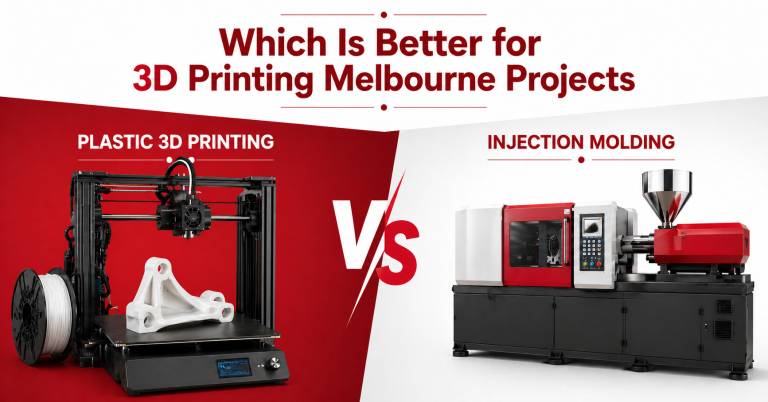
3D printing vs injection moulding, If you’re developing a product in Melbourne, there’s a high chance you’ll face this decision early:
Should you go with plastic 3D printing or injection moulding?
On paper, both methods produce plastic parts. But in real-world 3D printing Melbourne projects, choosing the wrong one at the wrong stage can cost you time, money, and scalability.
Here’s the truth most blogs won’t tell you:
It’s not about which is better—it’s about when to use each.
This guide breaks it down based on real project scenarios, cost realities, and what actually works for Melbourne businesses.
Understanding the Two Processes (Simple but Important)
We will discuss 3D printing vs injection moulding firstly:
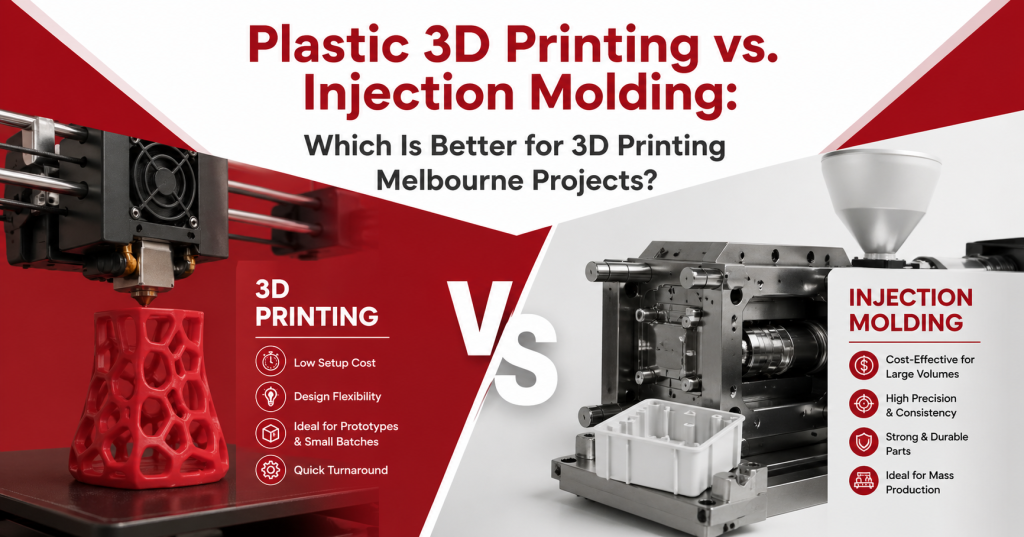
Plastic 3D Printing (Additive Manufacturing)
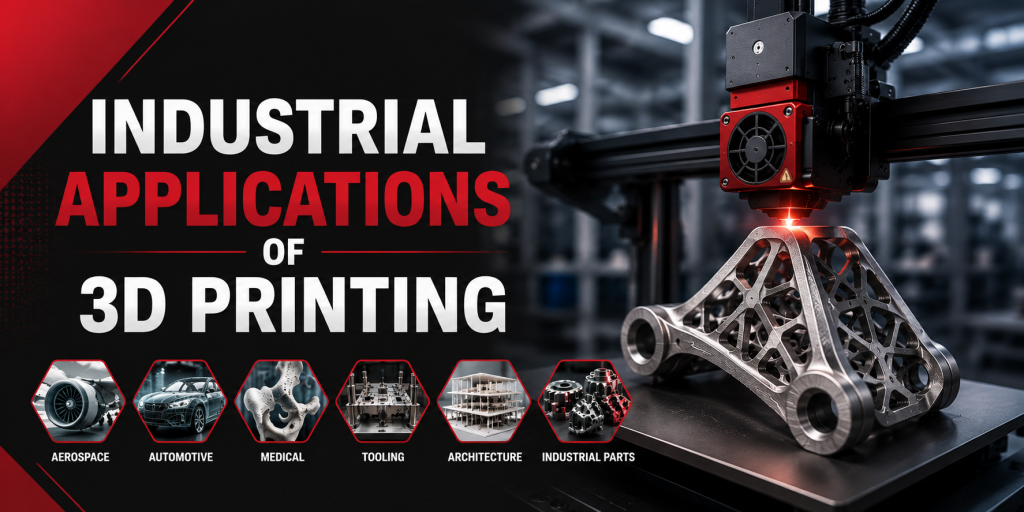
3D printing builds parts layer by layer from a digital file—no molds, no tooling delays.
It’s widely used across 3D printing services Melbourne for:
- Rapid prototyping
- Custom parts
- Low-volume production
This flexibility is why it’s the starting point for most modern product development.
Injection Moulding (Traditional Manufacturing)
Injection moulding involves creating a custom mold, then injecting molten plastic to produce identical parts at scale.
It’s ideal for:
- Mass production
- Consumer products
- High consistency manufacturing
But it comes with one major trade-off: high upfront cost and low flexibility.
The Biggest Mistake Melbourne Businesses Make
Here’s something we see often in real projects:
Businesses jump into injection moulding too early.
Why?
Because they focus on low cost per unit, without considering:
- Design changes
- Testing needs
- Market validation
The result:
❌ Expensive mold redesigns
❌ Delayed launches
❌ Wasted capital
This is why most successful Melbourne 3D printing workflows start with 3D printing—not molding.
3D printing vs injection moulding Cost Comparison
Let’s break this down practically.
Factor | 3D Printing | Injection Moulding |
Upfront Cost | Very low | Very high (tooling required) |
Cost Per Unit | Higher | Very low at scale |
Best Volume | 1–300 units | 500+ units |
Risk Level | Low | High (due to tooling) |
Reality Check
- If you’re building prototypes or small batches → 3D printing wins
- If you’re producing thousands of units → injection moulding wins
For most 3D printing Melbourne projects, early-stage production always favors additive manufacturing.
Speed: What Actually Happens in Real Projects
3D Printing (Fast & Flexible)
- No tooling required
- Same-day or next-day production possible
- Easy design changes
This is why 3D printing Melbourne CBD services are often used for urgent jobs.
Injection Moulding (Slow Start, Fast Scale)
- Tooling can take weeks
- Design changes are expensive
- Production is fast only after setup
If time matters, 3D printing is the clear winner.
Design Freedom: Where 3D Printing Dominates
3D printing allows you to create:
- Complex geometries
- Internal channels
- Lightweight structures
- Fully customized designs
Injection moulding requires:
- Simplified shapes
- Mold-friendly design
- Fixed geometry
For innovation, testing, and iteration, 3D printing is unmatched.
Quality & Strength: A Balanced View
Injection Moulding
✔ Smooth finish
✔ High consistency
✔ Strong, uniform parts
3D Printing
✔ Great for functional testing
✔ Improving rapidly with new materials
✔ Slightly weaker due to layer bonding
Real Insight
For 90% of early-stage products, 3D printing quality is more than enough.
You only need injection moulding when:
- You’re selling finished consumer products at scale
- Surface finish and uniformity are critical
Real Melbourne Workflow (What Actually Works)
Here’s the approach used by smart businesses:
Step 1: Start with 3D Printing
Use 3D printing Melbourne services to:
- Test your idea
- Validate your design
- Reduce risk
Step 2: Iterate Quickly
Make improvements without expensive tooling changes.
Step 3: Validate Market Demand
Ensure your product actually sells.
Step 4: Move to Injection Moulding
Scale production once everything is finalized.
This hybrid approach is the most cost-effective and least risky strategy.
Local Insight: Why 3D Printing is Growing in Melbourne
Melbourne’s innovation ecosystem is driving demand for:
- Faster prototyping
- Custom manufacturing
- On-demand production
Businesses are moving away from traditional methods because:
- Supply chains are unpredictable
- Product cycles are shorter
- Customization is in demand
This is why 3D printing Australia is seeing rapid growth—especially in urban hubs like Melbourne.
Where Caddeziners Adds Real Value
For most projects, the challenge isn’t just printing—it’s making the right decisions early.
Caddeziners supports Melbourne businesses with:
- Fast and reliable 3D printing Melbourne services
- Design optimization for better results
- Rapid prototyping for faster product development
- Support from concept to final production
This helps you:
✔ Avoid costly mistakes
✔ Launch faster
✔ Scale confidently
Common Mistakes to Avoid
❌ Choosing Injection Moulding Too Early
Locks your design and increases risk
❌ Skipping Prototyping
Leads to expensive redesigns later
❌ Ignoring Design Optimization
Slows down production and increases failure rates
❌ Focusing Only on Cost Per Unit
Instead of total project cost
Final Verdict: Which Should You Choose?
Let’s simplify it.
Choose 3D Printing if:
✔ You need speed
✔ You’re developing or testing a product
✔ You need flexibility
✔ You’re producing low volumes
Choose Injection Moulding if:
✔ Your design is finalized
✔ You need large-scale production
✔ You want consistent, high-quality output
In conclusion, Plastic 3D Printing vs Injection Moulding comes down to your project needs, budget, and production goals.
The Smart Answer (What Actually Works)
The best choice isn’t one or the other.
Use 3D printing to develop
Use injection molding to scale
That’s how successful 3D printing Melbourne projects are executed today.
I hope you now clearly understand Plastic 3D Printing vs Injection Moulding through this guide.
Call to Action
If you’re planning a product and need fast, reliable 3D printing Melbourne services, Caddeziners can help you go from idea to physical product—without delays or unnecessary costs.